
The Science Panel for the Amazon is an independent network of more than 200 scientists, researchers, and Indigenous knowledge holders from Amazonian countries and around the world. It was established to provide evidence-based guidance on the ecological, social, economic, and climatic challenges facing the Amazon and to inform decision-making by governments, businesses, civil society, and international organizations.


Synthesis of Key Recommendations across 18 SPA-Policy Briefs
The SPA's policy briefs are concise, science-based publications that translate research findings into practical recommendations for policymakers and stakeholders.


The Science Panel for the Amazon’s policy briefs converge on
a central message:
The Amazon is approaching critical ecological tipping points, but coordinated action can still secure a future in which conservation, climate stability, human well-being, and economic development reinforce one another.
Across all the Policy Briefs, six major recommendations emerge:
1. Halt Deforestation and Forest Degradation Immediately
The SPA identifies stopping deforestation, degradation, and ecosystem fragmentation as the highest priority. This requires stronger enforcement against illegal logging, mining, and land grabbing; improved land tenure systems; and better monitoring of forest loss. Protecting remaining intact forests is considered more effective and less costly than attempting to restore them after they are lost.

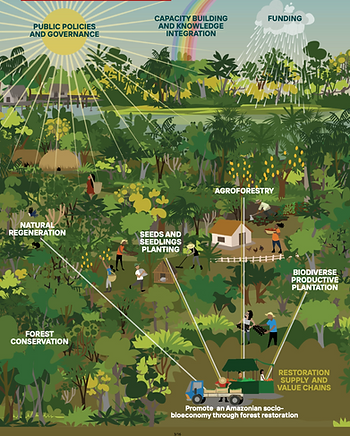
2. Expand Restoration at Landscape Scale
Conservation alone is no longer sufficient. The briefs advocate large-scale restoration of degraded lands, particularly in heavily deforested regions. Restoration should reconnect fragmented habitats, recover ecosystem services, enhance carbon storage, and strengthen resilience to drought and climate change. The proposed “arcs of restoration” approach focuses on strategic areas where restoration can generate the greatest ecological and social benefits.
3. Strengthen Indigenous Rights and Territorial Protection
A consistent finding throughout the publications is that Indigenous Territories and Protected Areas are among the most effective barriers against deforestation. The SPA recommends strengthening legal recognition of Indigenous lands, supporting Indigenous governance systems, protecting environmental defenders, and incorporating Indigenous knowledge into environmental management and policymaking. Indigenous peoples are viewed not simply as stakeholders but as essential partners in maintaining Amazonian ecosystems.


4. Build a Regenerative Amazonian Economy
Rather than relying on extractive activities that degrade ecosystems, the SPA promotes socio-bioeconomies based on standing forests and flowing rivers. Recommended investments include sustainable forest products, biodiversity-based industries, agroforestry, fisheries, ecotourism, and value chains that reward conservation. The briefs also emphasize developing science, technology, and innovation hubs that can support locally driven entrepreneurship and create economic opportunities without increasing forest loss.
5. Redesign Infrastructure and Urban Development
Infrastructure planning should be aligned with conservation goals. Roads, dams, and other large projects should be evaluated for their cumulative ecological impacts and designed to avoid accelerating deforestation. At the same time, Amazonian cities should become engines of sustainable development through investments in renewable energy, resilient water systems, public health, education, nature-based solutions, and improved public services. Urban policy is presented as a critical but often overlooked component of Amazon conservation.

6. Manage the Amazon as an Integrated Socio-Ecological System

The SPA argues that forests, rivers, biodiversity, climate, and human communities are deeply interconnected. Policies should therefore protect freshwater connectivity, address growing drought risks, integrate environmental and public health objectives, and recognize the Amazon’s role in regulating regional and global climate systems. The briefs repeatedly call for cross-border cooperation among Amazonian countries because ecological processes do not follow political boundaries.
Overarching Message
The publications collectively frame the Amazon not as a choice between conservation and development, but as a choice between destructive development pathways that undermine long-term prosperity and regenerative pathways that maintain forests, support local communities, and stabilize the climate. The SPA’s overall recommendation is a coordinated strategy built on attaining zero deforestation by 2030, large-scale restoration, Indigenous leadership, sustainable bioeconomies, resilient cities, and regional cooperation to move the Amazon away from ecological tipping points and toward a sustainable future.


